
Living In The Question
My curiosity about what causes people to be at their best led me to the leadership development field and to work for Kurt and Patricia Wright at Clear Purpose Management. Although I worked with them for a relatively short time, some of the concepts they taught left a lasting impression on me.
The cornerstone of the work there was about the distinctions in questions and the impact they have in the results we are able or not able to produce.
During this time, I realized how much the questions I had been conditioned to ask myself (for example, What is wrong with me? Why can't I do anything right?) were what was causing many of the obstacles in my life. This insight was profound and I began to ask myself and others different questions.
My career in leadership development continued with the focus, what makes an effective leader? Leaders that tended to be most inspirational and have the best results asked the best questions, had higher levels of awareness and made better decisions - they were enlightened.
The body of work that I still teach today became known as Enlightened Leadership. My then partner, Ed Oakley and I co-authored Enlightened Leadership: Getting to the Heart of Change.
For me, enlightened leadership has two meanings.
First to be enlightened is to ‘turn on the lights’; to raise one's awareness; to begin to see options other than reacting in the same way over and over. This is especially true regarding the awareness of what questions a leader asks.
The second part of what it means to be an enlightened leader is to ‘lighten the load’. So much of the stress and effort experienced today is caused by our conditioning. For instance, when I first had a leadership role, I did what had been modeled for me. - Told people what to do, how to do it and pointed out when how they were doing it was wrong. That first leadership role did not go well.
I have come to realize that my mind is a question-generating machine. Pay attention to yours and my bet is that you'll have the same result. Since I am always running on questions (consciously or unconsciously), my intention is to choose ones that move towards what I want with the least stress and effort.
What's next?
How can I best achieve my goal?
What will work best this time, in this set of circumstances?
Is this (action) the right thing to do now?
A natural progression of this intention was to begin questioning those things that are taken for granted, i.e.: the things we have always done or the way we do it.
I refer to this as Living In The Question - using questions to create positive results, flow and energy.
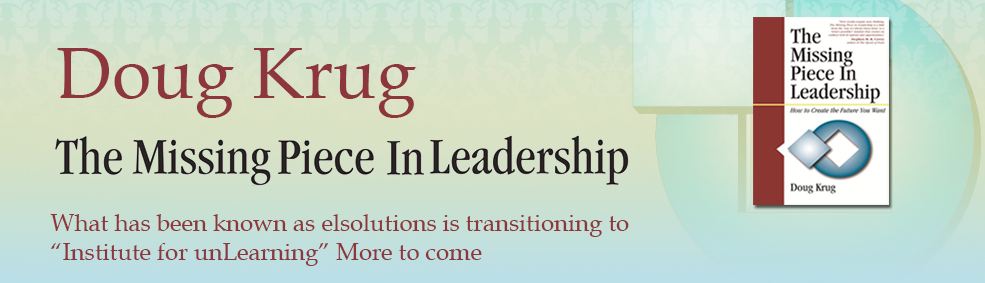
My latest book, The Missing Piece in Leadership, covers the evolution of thinking and the work we do at e.l.solutions, Inc.
It is in the spirit of Living In The Question that I wanted to write this blog. The purpose of this blog is to enhance the learning from the book and to build on the learning by continuing to ask,
How can we (I) create more of the results we (I) want without stress and effort?
I am excited to see what the answers are and what evolves from them!